
My attempts at curing green olives have not always been successful. The methods that I 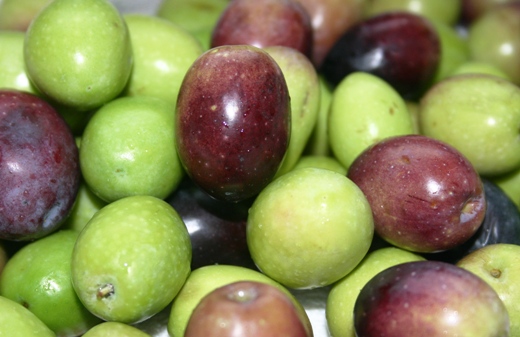 had heard about from local farmers involved putting the olives in a salt water brine – though the amount of salt varied wildly – or washing the olives daily for months, and paying the ensuing water bill. In fact, after throwing out my third batch of ghastly smelling soggy olives that I was too afraid to taste, I decided to give up on curing green olives.
Then a neighbor showed me an easy way to cure olives that does not require a long brining process, or checking on them on a daily basis and constant water baths. This inspired me to try again.
Though this recipe is easy, it does take time for the olives to finish curing before they are edible, but they can be put away on a shelf and forgotten about for a couple of months.
Here’s how to cure green olives:
1 ½ lbs. (680 grams) fresh green olives
1 carrot, finely diced
2 stalks of celery, finely diced
1 qt (1 liter) white wine vinegar
1 TB (1 soup spoon) sea salt
½ cup (120 ml) water
Olive oil to cover
Wash and dry the olives, which should be firm and healthy. It is okay if some of the olives have ripened to the partially black stage and they have a purplish blush. In Sicily, we call these “black and white olives” (even though they are purple and green!)
With a sharp knife, make 4 incisions lengthwise on each olive, spacing the incisions 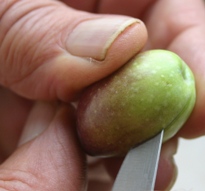 evenly apart- don’t worry, no one is going to measure.
Place the olives with their incisions in a non-reactive bowl with the finely chopped carrot and celery. Add the salt, water, and enough vinegar to cover the olives. (If you have a larger amount of olives than this recipe, increase the water and salt accordingly.) Mix well and cover with a paper napkin.
Stir the contents of the bowl once or twice a day. After 4 days, the olives should have darkened to a fairly uniform dark green color, and become soft (but not mushy.) If they are still hard, wait another day.
Drain the olive/vinegar mixture in a colander. Make sure that you drain the mixture very well-wait a few minutes and toss the olives in the colander to get rid of excess liquid.
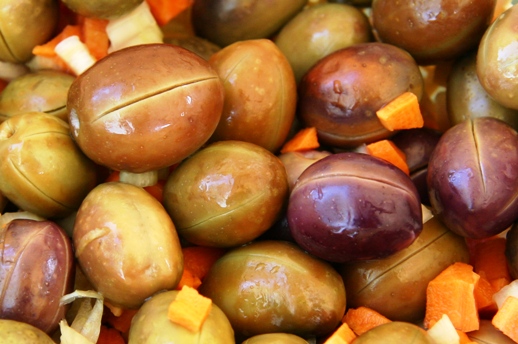
Put the drained olive mixture in a clean storage jar (1 ½ – 2 qt or 1 ½ to 2 liters) and cover the olive mixture with good olive oil. Make sure the oil covers the olives so that 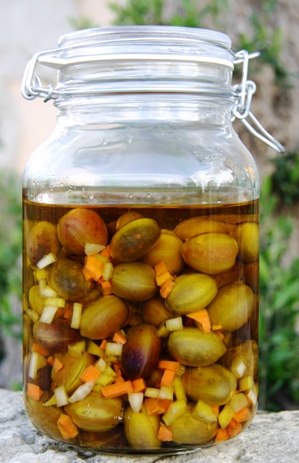 they are completely submerged. The olives should not rise above the oil or they will spoil.
Now comes the hard part – waiting. Place the jar of olives in a cool dark place and let them rest for at least 2 months before tasting. The olives should have a pleasantly acidic taste from the vinegar, which has been balanced by the oil.
Some ancient olive trees in Italy have been producing olives for hundreds of years. Read about Saracen olive trees.
Read similar posts: How to prepare lampascioni.
I live in Spain, and we have special high-sided wooden trays which are pierced with 3 holes of varying sizes, each with 4 blades at the side. The olives are pushed through the appropriately sized hole and emerge with four cuts, and then fall into a large ceramic (or plastic) bowl which you have rested the board on top of.
We place these bowls of slashed olives under the down pipe from our roof guttering, as our rainy season coincides with the olive harvest. After approximately a month all bitterness and tannin has been removed, then we marinade with fennel seed, bitter orange rind, garlic cloves, wine vinegar and olive oil. Peppercorns and salt of course.
Very interesting equipment- I like the flavor combinations, though not so sure about the pipe- lot of strange things find their way into my rain gutters.
I have just completed a month of curing green olives in water, changing the water twice a day. This is my very first attempt to cure olives. I noticed that some olives have changed from bright green to a darker olive color. Should I wait longer to put them in a brine or won’t they ever all have a uniform color? Also I love the fact that you are giving me a traditional Italian recipe for the brine. I guess it’s in my blood, my family has had olive orchards in Sicily for generations. Since I have had my olives in water for 30 days, can I adapt your recipe at the point?
Hi Nadine- I am not sure about the method you are using, but since the goal is to get rid of the bitterness from the olives, I would suggest that you taste them- if they are still bitter, continue soaking (I would tend to think they should all be close to the same color when ready.) When the olives are ready (no longer bitter), no, you would not use my process for curing olives, as you have already “cured” yours by soaking. I believe at this point you can dress them with oil and herbs-store covered in oil to avoid spoilage, or keep a smaller quantity of dressed olives in the fridge. Good luck!
Is there no need to put them in a water bath?
That’s right Debbie, no need for water bath. Just make sure that olives have lost their bitterness before going to the adding the oil stage. Let me know how they turn out!
If the olives turn dark is because they were not submerged in the first process. My recipe takes a very long time. However, part of the process you describe is the same: ten days, twice a day, submerge the olives. I put them in jars right away and use the usual mixture of the egg floating. I put two teaspoons of vinegar. Close the jars with the boiling water method. The olives will take at least seven months, from September till March or April. But, my olives last at least four years and more. So, I have olives year round, and when the following fall arrives, I’ll start again. Aribbon and give many jars away for the holidays. You will never fail, if you willing to wait seven months. By the way, I believe that olive oil turns the olives bitter again. Ciao
Ok, here I go. I will get back to you in a few months. Missing Italy as I read your blog…ciao for now.
I shall await your results!
Just opened up my jar. They are perfectly crunchy, not bitter at all. Wonderful! Thanks for your blog. I will continue to spread the word!
So glad to hear your olives turned out well, Chef. And yes, spread the word!
I just need a little clairity on the recipe.. After the four days of soaking in the mixture then you drain the olives but do you remove the carrots and celery when you drain? Then after you drain do you put the olives and NEW fresh carrots and celery and salt water and vinegar and olive oil in the jars… Or do you just use the olives and old carrots and celery in the jars with only olive oil to cover the olives? Thank you in advanced as we are first time olive curers 🙂
Nicole- You don’t remove the carrots and celery, and after the soaking period, the entire mixture is drained of vinegar and covered with oil. Just make sure bitterness is gone from olives before draining. Let me know how they turn out!
I was surfing the net for preserved lemon recipes and stumbled upon several videos and blogs for preserving olives. Most used lemons in the preparation thats why they were on preserving lemon sites. Last year I tried putting olives in a jar with salted water, but they foamed and were moldy and slimy!. Yuk! However… this year armed with my new knowledge I will try again with a combination of ideas that seem to make good sense. First, you put one layer of olives in a ziplock bag and with a meat tenderizer (or a rock as my mother in law does) crack the olives. Then, soak the olives for 3- 4 days in water. This will help to get the bitterness out but also I think it will help with the curing. Second, Make a brine of salt and water and place an uncooked egg in the water. If the egg floats there is enough salt! No kidding! It really works. Third, place a slice or two of lemon in the jar, put in the olives and spices that you like. Fill the jar with the brined water. Finally top with a good tablespoon on olive oil. This will hold the olives under the water. Then comes the hard part… waiting at least 4-6 weeks. Ususally we spice the olives after you open the jar and rinse them. We use hot pepper flakes, olive oil, finely chopped garlic and oregano. A chunk of bread, a piece of cheese, a glass of wine and thats dinner! Ha! Thanks for posted your method I learned yet another trick to good olives.!
Sounds good!
My local produce stand has fresh green olives available today. I\\\’m going to give it a shot curing my own olives following Anita\\\’s recipe. Excited! Hopefully , they will be ready to serve by Thanksgiving!
Can I store my olives in a mason jar or should I find the storage jar you pictured above? Will any jar do or does it have to be sealed like in the canning process? Thank you.
Do the olives need to be stored in a jar that is sealed as I the canning process? Or just a lid that you turn shut?
No canning processing needed. Have fun!
Sounds Good!
We do the green olives every oct, my mother in law and I.
Our ceramic pot with lid for doing our olives has cracked.
Can u tell me where I can get her a new one. This pot has a lid also a wooden insert which then held in place by a stone.
I would love to surprise her with a new one
Tkx
Hello,
I hope you will have time to help me out with a reply.
I am trying to cure green olives using my mother-in-law’s greek water method. We have been soaking the olives in fresh water (changing the water every day) for the past 20 days. We started adding a mild salt water to the bucket to preserve the olives and now two days later some of the olives are “bursting” and some are mushy. I am hoping you can tell me if all lost? I have changed the water every day including the past two days with the mild salt solution. I just saw the olives now and I changed the water as usual and noticed the issue. I hope you will be ale to send me a reply to my email… I will also check in here as well.
Thank you in advance for helping with your knowledge!
Yogi
Hi Anita
I am in Canada and bought a box of black California olives. I have been soaking them for a couple of weeks now changing the water everyday.
They are starting to change colour….getting lighter. Is that normal? Also, I’m not sure about the smell. Any tips you could give me would be much appreciated. Thanks.
My method is for green olives – for black olives I have only tried salt curing. Good luck just the same!
Hello, I have a question, I have been curing my olives for about 4 months and they are still bitter. Can I do anything to change that? I thought they were done, I have them soaking now in just water to leach some of the salt that they brined in. I am not sure what to do at this point.
Thank you,
Tracey.
Hi Anita I enjoy your blog and I’m into the 5th day following your recipe how to cure green olives and they’re still not softening and quite hard. Also the olives colours have changed to a mottled dark green/grey. Could you please advise me of your suggestions? Thank you kind regards Colleen
Ciao! Anita
My father is from Sicily but emigrated to the United States, via NYC (age 13) to Hartford, CT then to Boston, Massachusetts where he met my mom. I now am 54 yr. old live in Maryland, my dad is 80 yrs old.. I came across some huge green olives at the Asian market I frequent. I was thrilled. My dad, Salvatore, brined olives for years growing up. He salted them first, then would add the spices, cure, then finally add the olive oil. All these years have passed and now its my turn, but I will use your recipe, because I cannot find more than a jar of olives to brine/cure. So wish me luck, I will let you know. Thank you for your posts, recipes, and fabulous web pages. I hope one day to visit your home to.
Just put my batch on oil! So excited! Thanks for the recipe.
Hello, I have 2 large jars of olives (1 green, 1 black) which are ready – they taste lovely. I want to put them in smaller jars to give away, Do I put olive oil or water in the jars with them (they are salty enough) or do I put them in a milder brine. Thanks in advance. Sue
I have had my very bitter olives in the refrigerator changing the water since November!!! It is January. They have no bitterness. I have been eating one a day when I change the water. They look good. Was this too long to water cure? are they safe?
Thanks so much for your site. Great information.
I stored my olives for 4 months and changed water to get bitterness out of them. I have tasted them every week. I am now ready to bottle them. Was that too long to water cure?
The olives should be fine, as they were in the fridge.
Another recipe for curing green olives right off the tree!
Mom brought this right from Sicily!
Olivia Schiacciato…
With a small wooden mallet crack the olives to open the flesh!
Put olives in a vessel and fill with enough water to cover them!
Pour sea salt ( about a cup and a half ) Kosher salt is what I use.
Change water daily with fresh salt til bitterness is purged out and they are sweet to the taste?
leave olives in just plain water and in a cold area .
For best results to preserve olives I cut up celery, diced . Vinegared pepperinchino peppers, vinegared califlour , and the olives with olive oil, Italian spices, some vinager , go very easy with the vinager , taste as you add!
The sea salt amount is for a case of olives!
If you chose to make smaller amounts, ( like a few pounds at a time ) use much less salt! Just make water salty!
The recipe sounds great. Question … once completing the curing and preserving process, what is the shelf life for the olives before they go bad? I want to make sure I don’t make to many at one time. Thank you!
They should keep up to a year.